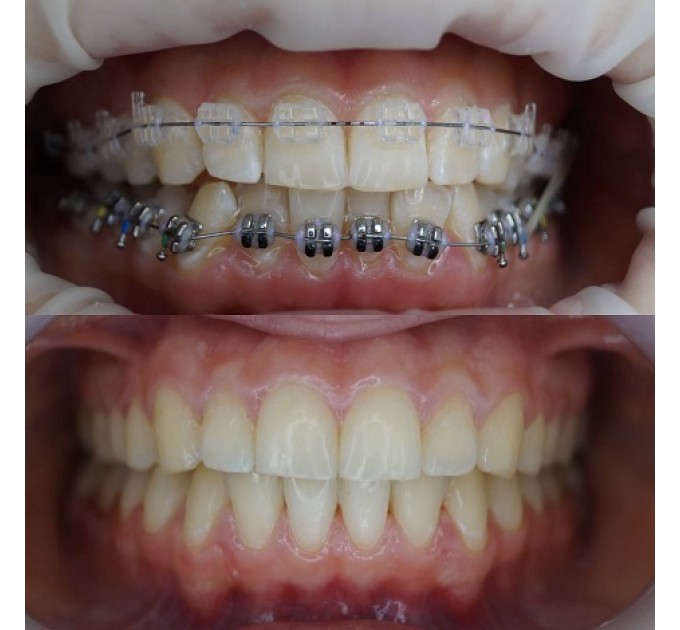
Contraindications to the installation of braces are mostly relative. The decision to correct the line of the tooth row is based on the results of the dental examination, the general clinical history of the patient and, subject to an objective assessment, the readiness to wear an orthodontic product.
Classification of bracket systems
By location:
• vestibular bracket system — is a classic variant of installation on the outer surface of the tooth
• lingual bracket system — fixed on the inner surface of tooth enamel, so the treatment is invisible to others. Despite high aesthetics and inconspicuousness, lingual braces have a number of significant features. Lingual braces are more often installed in adults. This is due to the fact that children often have such problems as trauma to the mucous membranes of the oral cavity, difficulties in hygiene, distortion of diction, lisping and profuse salivation. The adaptive period is long.
According to the method of fixing the arc:
ligatures - the arch is attached with the help of ligatures - special fastening elements made of metal or plastic material.
self-ligating braces - the arch is attached to micro locks. The self-ligating bracket system is visually less bulky and more aesthetic.
According to the material of manufacture
The most significant for patients is the classification that determines how the dentition will look during the entire treatment. Depending on the material of manufacture, braces can be:
- metal;
- ceramic;
– sapphire;
- combined.
1. Metal - standard designs made of metal alloy. The advantages are availability, strength and treatment of any bite pathology. However, not everyone chooses metal structures because of poor aesthetics. Patients over 20 years of age with normal self-esteem prefer to have metal braces placed on their teeth.
2. Ceramic. Quite strong and beautiful products literally match the shade of the enamel, but the advantages end there. Ceramic braces are not used for gross bite defects. Products are painted with food dyes and reduce aesthetics, and are also unstable to mechanical impact.
3. Sapphire braces are an ideal option for people who care about their smile during treatment. They are invisible on the teeth and the patient does not feel psychological discomfort. They are made of artificial sapphire for medical purposes, which is distinguished by its strength, reliability and aesthetics. These materials are grown using the same technologies as jewelry crystals. Sapphires are transparent and colorless, they shine spectacularly when the sun's rays hit them.
Clear sapphire braces have many advantages:
• they look beautiful in the oral cavity and are practically invisible;
• reliable and strong;
• are not stained by food products, drinks and nicotine;
• the patient quickly gets used to them, and does not injure the mucous membranes of the oral cavity while eating;
• do not distort speech;
• due to the beautiful shine, they look like a decoration.
4. Combined braces are a reasonable compromise between aesthetics and functionality. The innovation consists in the installation of inconspicuous vestibular braces in the area of the smile and metal braces in the area of the chewing teeth. In some cases, it is possible to combine bracket systems on the jaws: an aesthetic, inconspicuous bracket system (ceramic, sapphire) is installed on the upper jaw, and a metal bracket system on the lower jaw.
Installation of braces in children is carried out after the complete change of milk teeth to permanent ones, that is, with a fully formed permanent bite.
STAGES OF ORTHODONTIC TREATMENT
Orthodontic treatment consists of the following stages:
1. Consultation and diagnosis. This includes an examination by a dentist, assessment of the condition of the oral cavity, establishment of a diagnosis and appointment of additional examination methods. Depending on your clinical situation, the specialist will advise the best treatment options. When the method is chosen, it is necessary to take a survey picture of the jaws (orthopantomogram) and take impressions from both jaws.
2. Preparation for bite correction. At this stage, the oral cavity is prepared for installation of selected orthodontic structures. The dentist replaces old fillings, treats caries, pulpitis, periodontitis and other inflammatory processes. If necessary, wisdom teeth are removed - in order to increase the space for other teeth.
3. The main stage is installation of selected orthodontic structures.
This is the longest and most important stage. Here, with the help of removable (dental plates, mouthguards) or non-removable (braces of various types) mechanisms, the bite is corrected. During the treatment period, the orthodontist adjusts and adjusts these constructions. It is important to visit the dentist on time and follow all his recommendations on lifestyle and dental care. Then the treatment will not be complicated and will be effective.
4. Retention stage.This is the time to consolidate the result after the main stage. After removing the orthodontic structures, it is important to fix the teeth in the established position and prevent their distortion. Removable and non-removable devices are also used, which are worn for a certain period of time, depending on the recommendations of the orthodontist.