
Wisdom tooth removal
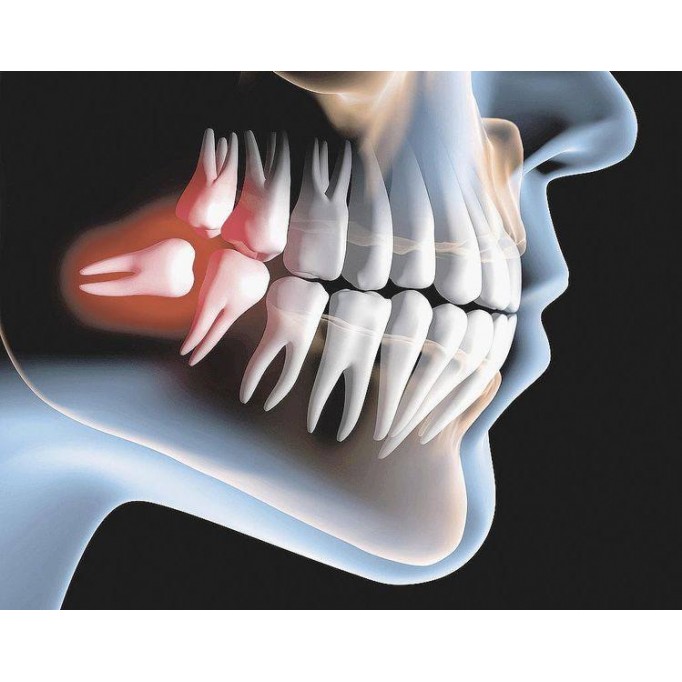
Wisdom tooth removal
Removal of third molars, or so-called "wisdom teeth", deserves special attention. Unfortunately, most people experience problems with these teeth to one degree or another. Why is this happening? Let's try to find out. In connection with a change in the diet - a reduction in the consumption of solid and hard food - the size of the maxillofacial system of most people gradually decreases. Since the eighth teeth, or wisdom teeth, are laid down, formed and erupted last, as a rule, there is no full space for them in the tooth row. Therefore, the following situations may occur:
• dystopia – incorrect position of the wisdom tooth;
• retention or semi-retention - complete absence or partial eruption of a wisdom tooth due to the presence of a mechanical obstacle.
In the future, such conditions can lead to a number of complications, namely:
• purulent inflammation in the pocket ("hood") formed between the gums and the wisdom tooth - pericoronaritis;
• caries of the eighth tooth (wisdom tooth) or an adjacent tooth due to the impossibility of adequate hygiene of this area;
• chronic injury of the mucous membrane of the cheek due to the incorrect (so-called buccal) position of the third molar;
• violation of the position of the frontal group of teeth due to excessive pressure from the retained tooth.
Due to the fact that such teeth have an incorrect position, the specifics of removal, the duration of the operation for their removal and the postoperative period itself may differ from traditional removal.
Removal of wisdom teeth is indicated if they do not grow properly or if the jaw is small and there is not enough space for other teeth. Wisdom teeth do not carry a functional load, that is, they do not participate in the chewing process. Therefore, their removal does not entail serious consequences. It should be noted that wisdom teeth should always be removed. If the tooth has grown correctly and does not affect the position of other teeth, then it can not be removed. Otherwise, deletion is necessary.
Also, removal of wisdom teeth is one of the first stages of orthodontic treatment.
Care and recommendations.
It is important to understand that the tooth extraction process belongs to the class of surgical operations. Even after a simple operation, the healing of the hole will be accompanied by rather unpleasant sensations in the oral cavity. To ensure maximum comfort after tooth extraction, you should follow the following recommendations:
• In case of heavy bleeding: after the operation, the doctor will put a gauze tampon on the hole, but if the bleeding does not stop after twenty minutes, then you need to replace the tampon yourself and apply it for another hour. In the further process of healing, it is also necessary to apply a gauze tampon during bleeding.
• After the painkiller wears off, there is a moment when the pain manifests itself. Ideally, after returning home from the dental office, it is recommended to sleep. If the pain does not allow you to do this, then you need to take an analgesic.
• In severe pain, you can apply cooling compresses.
• It is not recommended to engage in physical activity two to three days after tooth extraction.
• It is necessary to exclude from your diet nuts, hard meat, very hot and very cold foods and other dishes that irritate or burden the oral cavity.


